Showing posts with label History. Show all posts

Sunday, July 27, 2014

FILIPINO | Paano natin nakalimutan si Marcos?


Those who cannot remember the past are condemned to repeat it,” ang sabi ng Espanyol na manunulat at pilosopo na si George Santayana.

Ang kasabihang ito ay tila nagbabadya ng katuparan sa ating lipunan ngayon. Sa dami ng mga taong tila nakalimot na sa ating pinagdaanan mahigit 40 taon na ang nakakaraan, malamang ay makakakita na naman tayo ng isang Ferdinand Marcos sa Malacañang.

Sa mga dumanas ng kaliputan sa ilalim ng Batas Militar, para bang kahapon lamang nang maganap ang mga karumal-dumal na pagpatay, ang walang habas na paniniil, at ang mala-kamay na bakal na pagpigil sa ating kalayaan matapos ang ika-23 ng Setyembre, 1972 (Nilagdaan ni Marcos ang Proklamasyon Blg. 1081 noong ika-21 ng Setyembre).

Subalit sa tinaguriang Facebook Generation—mga Pilipinong ipinanganak matapos ang rehimen at rebolusyon—ang mga pighati, sakripisyo, at pag-aalay ng buhay na ito ay tila wala nang saysay sa kanila.

Bakit nga ba tayo humantong sa ganito? Paanong nakalimutan ng bagong henerasyon ang ating mga ipinaglaban sa kabila ng taunang paggunita dito? Ano ang maaari nating gawin upang di tuluyang magkatotoo ang mga salita ni George Santayana sa ating panahon?

Ang pagkalimot ay nakasulat na sa kasaysayan

Ang kasaysayan ay puno ng mga pangyayari na kung saan tila ba nakalimot ang isang bansa o lipunan sa kanilang ipinaglaban ilang taon o dekada ang lumipas matapos ang pangyayari.

Isang halimbawa ay ang Rebolusyong Pranses mula 1789 hanggang 1799. Sa loob ng sampung taong panahon na ito, pinatalsik ng lipunang Pranses ang kanilang hari na si Louis XVI at nagtatag ng isang malayang republika na kumikilala sa karapatang pantao.

Subalit, ang kaguluhang dala ng tinaguriang Reign of Terror mula 1793 hanggang 1794 ay nagdulot ng pagkakawatak-watak ng republika at ang pagluklok ng mga Pranses sa isang panibagong hari, si Napoleon Bonaparte.

Isa pang magandang halimbawa ay ang Una at Ikalawang Digmaang Pandaigdig (1914-1918 at 1939-1945). Matapos matalo ang Imperyong Aleman at mga alyado nito laban sa pinagsamang pwersa ng Amerika, Britanya, Italya, at Pransya noong 1918, tila nakalimot ang mga Aleman sa mga aral ng digmaan.

Sa loob lamang ng 15 taon ay nailuklok naman sa pinakamataas na pwesto ng Alemanya ang diktador na si Adolf Hitler na nagdala sa daigdig sa isang panibagong digmaan.

Tila ba di makakalimutan ng mundo ang malagim na Final Solution ni Hitler, isang sistematikong programa ng paglipol sa milyun-milyong Hudyo, Gypsies, at mga Komunista, at hanggang ngayon ay isa sa pinakamalagim na bahagi ng kasaysayan ng daigdig.

Ngunit matapos ang Ikalawang Digmaang pandaigdig, sumulpot sa Alemanya noong dekada 50 at 60 ang mga Nachgeborenen o mga Alemang ipinanganak matapos ang digmaan.

Sa kabila ng masalimuot na kasaysayan ng kanilang bansa, nahirapan ang bagong henerasyong ito na makamit ang Vergangenheitsbewältigung o ang proseso ng pagtanggap sa kanilang nakaraan. Maraming kabataang Aleman ang tila di batid ang mga ginawa ng rehimeng Nazi, habang ang iba pa’y pinuri at binigyang pugay ito (ipinakita sa atin ito ng aklat ni Bernhard Schlink na The Reader).

Ang lipunang Pilipino sa ilalim ng makabagong henerasyon ay nakararanas din ng kabiguang matanggap ang kanilang nakaraan. Kaya di nakapagtatakang marami sa kanila ang hindi alam ang saysay ng Batas Militar at ng Rebolusyon sa EDSA.

Marami sa kanila ang aktibo pa nga sa pagpuri at pag-idolo kay Marcos at sa mga ginawa niya sa kabila ng malagim na resulta nito.

Paano tayo humantong sa ganito?

Ang mundo ay higit nang nababalot sa impormasyon. Ang Information Age ay nagdulot ng pag-usbong ng mga makabagong midyum kung saan ang impormasyon ay madaling likhain at palaganapin.

Sa halip na mga aklat at pahayagan, ang tangan ng mga kabataan ngayon ay ang Internet: isang alkansya ng kaalaman sa dulo ng ating mga daliri.

At dahil sa dali ng paglikha at pagpapalaganap ng impormasyon sa Internet, naging pagkakataon ito sa mga loyalista ni Marcos upang magpakalat ng mga kasinungalingan at iretoke ang imahe ni Marcos.

Isang Marcos na taga-pagligtas ng demokrasya laban sa komunismo. Isang Marcos na nagpaangat sa Pilipinas upang maging pinakamatatag na ekonomiya noong panahon niya.

Sa kasamaang palad, madaling maniwala ang bagong henerasyon, nang walang pagsusuri sa pinagmulan ng impormasyon at sa katotohanan sa likod nito.

Ang sitwasyong ito ay lalo pang pinalala ng ating masalimuot na sistema ng edukasyon sa bansa. Dahil sa pagbibigay-diin sa mga paksang gaya ng Matematika, Ingles, at Siyensya, napabayaan at di nabigyan ng sapat na pansin ang pagtuturo ng kasaysayan.

Ang mga pangunahing subject na ito ay may mas mahabang oras ng pagtuturo at mas malaking unit sa pagmamarka. Kadalasan pa nga’y nabibigyang diin din ito ng mga kaakibat na elective subjects.

Ang kasaysayan ng Pilipino ay naibaba bilang isang minor subject at itinuturo na lamang ng tatlong beses (minsang pa nga’y isang beses) sa isang linggo, sa loob lamang ng 40 minuto hanggang isang oras.

Dahil kulang ang oras, sa pagtatapos ng taong pampaaralan, ang pagtalakay sa kasaysayan ay kadalasang umaabot lamang sa panahon ng mga Amerikano o ng mga Hapon. Ang panahon ng Ikatlong Republika, Martial Law, at Rebolusyong EDSA ay mga pahina sa mga aklat na di man lang nabubuklat.

Hindi rin itinuturo ang kasaysayan batay sa mga pangunahing batis o primary sources. Hindi tuloy nalalaman ng mga mag-aaral kung paano magsuri ng mga batayan ng impormasyon, kung totoo ba ito o may kinikilingan. Walang matinong pagsasanay ang mga mag-aaral sa historyograpiya.

Kaya naman paniniwalaan ng mga kabataan ngayon ang anumang maganda tungkol kay Marcos, basta't nasa Internet ito.

Malaking balakid din ang pagkakaroon ng mga gurong walang tamang pagkakaunawa sa kasaysayan. Sa Ilocos Region at sa lalawigan ng Leyte, may mga gurong itinuturo ang Martial Law at Rebolusyong EDSA ng taliwas sa sinasabi ng kasaysayan.

Paano maaalala ng bagong henerasyon ang malagim na bahagi ng ating kasaysayan kung heto’t ang mga natuturo sa kanila ay mga loyalista ni Marcos na handang baluktitin ang mga pangyayari sa nakaraan?

Ang pag-aaral ng kasaysayan ay tungkol na lamang sa pagmemorya ng mga pangalan, pangyayari, mga pook, at petsa. Hindi na ito tungkol sa pagsusuri ng mga dahilan, ng pagtitimbang sa mga pagkilos ng mga grupo at indibidwal.

Sa kasalukuyang K to 12 Curriculum, higit na naibaba ang estado ng pagtuturo ng kasaysayan. Ang pagtuturo ng kasaysayan ng Pilipinas ay ibinaba na lamang sa Grade 5 at 6: mga baitang ng mga mag-aaral na wala pang kakayahan na malalimang suriin ang mga pangyayari sa nakaraan.

Sa madaling sabi, sa K to 12 Curriculum, tila ang kasaysayan ay nawalan ng saysay.

Nakalimutan nating magbantay

Subalit, kung may pinakamalaking dahilan upang makalimot ang bagong henerasyon tungkol kay Marcos, ito ay ang kalagayan ng bansa natin ngayon.

Apatnapung taon mula nang ideklara ang Batas Militar at halos tatlumpung taon mula nang maibalik ang demokrasya noong Rebolusyong EDSA, nananatili ang mga suliranin na kinaharap natin noon at siyang rason ng bagong henerasyon ngayon upang ikarangal ang palalong si Marcos.

Kahirapan. Kawalan ng oportunidad. Tatsulok na lipunan. Kriminalidad. Katiwalian. Political Dynasties. Padrino System. Ang maruming pulitikang ipinakilala sa atin ni Marcos ay nagpapatuloy sa kabila ng panunumbalik ng demokrasya.

Ito ay sumasalamin sa kabiguan ng ating lipunan na matutunan ang mga aral ng Batas Militar at EDSA. Inakala natin na sa pagpapalit ng administrasyon nagtatapos ang laban.

Nagkamali tayo ng akala. Hindi natin pinanatili ang pagbabago. Bagkus, hinayaan natin na ang halimbawang ipinakita ni Marcos ay magpunla sa puso ng ating mga lider at higit pang lumaganap hanggang sa ang buong sistema ay maging halos permanente na.


Hindi natin tinuruan ang bagong henerasyon na maging mapanuri, magmatyag, at magbantay. Hinayaan natin silang lumaki sa layaw, gawin ang mga walang kapararakang bagay, at maging bulag sa kanilang nakaraan.

Nabigo tayong magbantay. Nanumbalik tayo sa ating mga trabaho, sa ating tahimik na buhay.

Pagpapanatili ng pagbabago

Hindi pa naman huli ang lahat upang labanan ang mawalakang amnesia na ito sa ating bansa. Kung talagang gusto ay may paraan at may mga grupo at indibidwal na sumasabay sa nagbabagong panahon upang patuloy na ituro ang mga aral ng nakaraan.

Suportahan natin sila. Makibahagi tayo sa pagpapaalala at pagpapalaganap ng katotohanan. Palaganapin ninyo ang pahayag na ito, sa inyong mga kaibigan, kakilala, lalong lalo na sa kabataan. 

At higit sa lahat, kumilos tayo upang makamit ng ating bansa ang pangarap nito na maalis ang kahirapan at kawalan ng oportunidad, sa pamamagitan ng patuloy paglaban sa katiwalian at maling gawain, nang naaayon sa katotohanan, katwiran, at katibayan.

Pagkat habang nananatili ang mga suliraning nagmula pa sa rehimeng Marcos, mananatiling siyang buhay bilang isang bayani sa mga mang-mang at walang muwang. Huwag ninyong hayaan na magpunla at mabuhay si Marcos sa puso nating lahat.

Sabi nga ni George Santayana: 

“Ang pag-unlad ay di lamang pagbabago; ito ay nakasalalay sa pagpapanatili ng pagbabago. Kung ang pagbabago ay tiyak, walang daan o sinuman na kailangan pang baguhin; at kung hindi mananatili sa atin ang alaala, gaya sa malulupit na tao, ang kawalan ng muwang ay habambuhay.”

Mga batayang batis:
Kennedy, Emmet (1989). A Cultural History of the French Revolution. New Haven: Yale University Press.
Evans, Richard J. (2003). The Coming of the Third Reich. New York; Toronto: Penguin.
Herf, Jeffrey. (1997) Divided Memory: The Nazi Past in the Two Germanys. Cambridge: Harvard University Press.
Bonner, Raymond (1987). Waltzing with a Dictator: The Marcoses and the Making of American PolicyNew York: Times Books.
Seagrave, Sterling (1988): The Marcos Dynasty, Harper Collins

Saturday, September 21, 2013

THINGS YOU NEED TO KNOW BEFORE IDOLIZING MARCOS


Early this month, I asked my fourth year students to create artistic posters of post-war/contemporary Filipinos who they consider as their heroes. This is part of our observance of National History Month last August. Initially, I am pleased with their outputs because most of it are well made and depicts popular personalities today like CNN Hero Efren Penaflorida, former DILG Secretary Jesse Robredo, former Senator Benigno Aquino Jr. and former President Corazon Aquino. Some even fielded lesser known names in the field of social change like Gawad Kalinga’s Tony Meloto, child wonder Kesz Valdez, RockEd founder Gang Badoy, and even rapper Francis Magalona.

However, I was struck speechless by what one student chose as his hero: former President and Dictator Ferdinand E. Marcos.

This incident is but a mere testament to the gravity of unawareness prevailing in today’s generation regarding the horrors of Martial Law and the abuses of the Marcoses and their cronies. In social media, you can observe how appalling this gravity is; it has washed clean the consciousness of every post-People Power Revolution generation beginning from those born in the 80s up to the millenials.

I am a 90s kid, but growing up watching news on TV and reading tons of newspapers and history books has made me fully aware of transgressions committed by the Marcos regime. But for people unlike me, I have a chilling fear that my generation (and generations to come) might not know what these transgressions are and that they might even revive the personality cult of this evil strongman. What could be influencing them even as we celebrated People Power annually for the past 27 years through street demonstrations and countless TV specials and granite memorials?

I’d like to believe there is an ongoing pro-Marcos lobby going on since 2010. While it cannot be directly tied with evidence, it is worth noticing that pro-Marcos videos, blog posts, and other social media have surged dramatically in the run up to the 2010 Presidential Elections where the strongman’s son and heir-apparent Bongbong Marcos first ran as senator and won. Of course, it is common knowledge where Bongbong is setting his sights on after securing his Senate seat.

Facebook and Youtube are all afire with conversations about FM being “the best president of the Philippines”, “that FM and Ninoy weren’t enemies but best friends”, and that “Cory Aquino handed Ninoy divorce papers” prior to his assassination. Marcos loyalists dominate and control the discussion in these sites using various statements to laud Marcos’ achievements and dismiss credible primary sources about his corruption and human rights record as mere manipulation by the media.

Let’s explore some of their arguments and counter them with common sense and (of course) with primary historical sources:

1. “Marcos is the best president! He built a lot of infrastructure projects that still exist today such as the San Juanico Bridge, the Patapat Viaduct, and the Candaba Viaduct. During his term, the PNR (Philippine National Railways) extends up to Bicol and Pangasinan!"

Three of Manila’s bridges—the Quezon, Jones, and MacArthur Bridges—were all built during President Manuel L. Quezon’s term. Also, the Manila City Hall, the PhilPost Building, and the National Museum, which were built during Quezon’s term and destroyed or damaged in World War II, were rebuilt during the time of President Manuel Roxas. It was also during Roxas’ term that the Manila International Airport (NAIA Terminal 1 today) was built from its original location in Nielsen Field (now Ayala Avenue, Makati). The Manila Railway Company (now the PNR), whose railway lines were also damaged during the war began its rehabilitation during the Roxas’ term and continued in succeeding administrations.

It is also worth noting that most of FM’s infrastructure projects were funded by loans from foreign creditors such as the IMF and the World Bank. Hence, Philippine foreign debt surged from $360 million in 1962 to $28.3 billion in 1986. Morever, Marcos and his allies are known to overprice these infrastructure projects in order to siphon kickbacks amounting to billions of dollars for their own personal whims.

It stumps me how the loyalists could laud Marcos’ infrastructure projects when other presidents before and after him have also fielded great engineering feats. All these infrastructure projects still exist and are being used; yet, very few have lauded the Presidents who envisioned them. So why single out FM as if he is the progenitor of all infrastructure projects in the Philippines?

2. “The Philippines’ had the best performing economy during Marcos’ time. The prices of commodities were cheaper compared today and the peso-dollar exchange was at a dollar per peso!”

Most people associated with this comment were born between 1940 and 1960. Give them a light tap in the shoulder and remind them that prices today are indeed higher today compared to the 70s because of changing inflation rates. Remind them too that back in their days, their grandparents used to say too that commodities were cheaper during the Commonwealth period.

Source: BSP
As for the economy being the best during Marcos’ term, no statistical record can substantiate this. Numbers don’t lie and even the Bangko Sentral ng Pilipinas has released records of the peso-dollar exchange being at P3.50 to a dollar in 1966 after Marcos came to power. When he left in 1986, it was at P20.53 to a dollar!

Moreover, our gross domestic product (the total amount of products and services produced in the country) dropped from 3.4% in 1966 to 1.4% in 1986. We fared poorly compared to our Southeast Asian neighbors who fielded better GDPs such as Thailand (5.3%), Singapore (7.7%), Indonesia (5.7%), and Malaysia (5.1%). Thus, despite “revolutionary” programs such as the “Green Revolution” (which were funded by loans), many Filipinos (especially in the countryside) suffered great poverty because of their inability to adopt and adjust to new farming techniques introduced by the regime which were beneficial only to the landed elite. Between 1972 and 1980, agricultural output went down by 30%, unemployment exploded from 6.8% in 1972 to 27.65% in 1985, thus leading to a 40% hunger and malnutrition rate among the general population in 1978 (when Martial Law was at its peak).

3. “Society was better during Marcos’ time; people are disciplined and were afraid to break the law.”

If this was the case, then the succeeding generations of those who were “disciplined” during Martial Law should be well behaved and even more disciplined by now since their parents (and grandparents) had a much “disciplined” upbringing! But this isn’t the case, since we have more shameless lawbreakers today in every fabric of our society, from the grassroots up to the elite. Why is this so?

Marcos conditioned society to fear laws instead of respecting them. If people followed laws in their own accord, they would be following it even without the fear of death or any other penalty. But during Martial Law, our constitution—the 1973 Constitution—was almost penned by Marcos’ hand because the Interim Batasang Pambansa was but a mere rubber stamp of his punitive policies.

Of course, who would follow a rule that was not agreed upon by everyone? No one. Thus, Marcos had to use fear to enforce his laws, even to the point of committing grave human rights violations. He conditioned society that he was doing all these to correct a “corrupt and undisciplined society”, but all of it is a pretext to what he planned as a silent doing away of all groups and figures who were opposed to his political and economic schemes which served himself, his friends, and his foreign political handlers.

4. “Marcos is not as corrupt as politicians today!”

Actually, he’s just as worse as them. Maybe even worse.

Given that his administrations’ economic “growth” was funded by international loans, he and his cronies had a huge cash cow in their tow. All in all, he accumulated $30 billion from foreign loans, government funds, and private businesses seized during Martial Law. From this amount, $450 million would go to various escrow accounts in Switzerland, lavish real estate properties in the United States (under the name William Saunders, an alias he used in World War II), as well as a collection of shoes and jewelry to please his wife Imelda who was pining over his unfaithfulness by having a sexual affair with actress Dovie Beams. This is aside from the fact that he used bribery and coercion to buy votes and rig the results of the 1969, 1981, and 1986 elections.

It can be said that the crooks and thieves of today’s society like former President Joseph Estrada, former President Gloria Arroyo, Senators Juan Ponce Enrile, Jinggoy Estrada, Bong Revilla, and Bongbong Marcos, as well as Janet Lim-Napoles, Gen. Carlos Garcia, Jocjoc Bolante, the Euro-Generals, to name a few, all took a page from Marcos’ book.

So why are many Filipinos still idolizing him now more than ever?

With every fabric of our society soaked in the bathwater of corruption, majority of Filipinos are left with very little choice. We have a president, whose agenda is to fight corruption, but can't fully get his hands on dismantling its gears and cables completely because he is afraid of losing popular support for his polices and his party in 2016. On the other side, we have extremist politicians who want to dismantle the very democratic foundations of this society and replace it with an undemocratic one. We already know what happened to these societies, right?

Hence, out of the need for order, continuity, and survival, some Filipinos would chose to look up to Marcos and his offspring. He was a strongman after all—a strongman who stole, lied, and cheated—but still a strongman compared to weaklings, cheats, and crooks of today. These Filipinos chose to forget their principles and deny the very truth in our history books because the post-EDSA breed of leaders and politicians have left them with very little to look up to.

If only they realize that they shouldn’t be looking up at anyone.

When it comes to our country’s good, we don’t owe anyone a favor, whether it’s Marcos, Estrada, or Aquino. We are a nation who implored the aid of God to set up a government that reflects our ideals and aspirations—ideals that are pure and chaste. But with our little education and feeble minds we were deceived by these people to trust them with our hands, minds, and pockets. Now that we know better, are we still going to trust our country’s good to these kinds of people and their offspring?

We owe it to ourselves to setup a good government and bring about a better nation. Hence, we shouldn’t elect strongmen (or women) to save us from ourselves and each other. We MUST save ourselves by being respectful of the covenants we made with ourselves and others: by respecting our laws against cheating, lying, stepping on each other’s rights (among others) and by upholding our laws that promote peace, community, cooperation, wealth-sharing, and mutual growth.

More than ever, we are the heroes who can save this nation. If only we remember and never forget. TSS

References:

Photo credits: GMA News Online and Ferdinand Marcos for President 2016 Facebook Page


Sunday, November 18, 2012

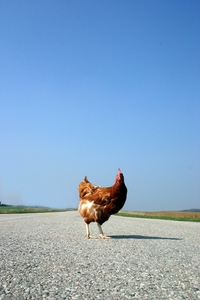
WHY DID THE CHICKEN CROSS THE ROAD?

Plato: For the greater good.

Karl Marx: It was a historical inevitability.

Machiavelli: So that its subjects will view it with admiration,
as a chicken which has the daring and courage to
boldly cross the road, but also with fear, for whom
among them has the strength to contend with such a
paragon of avian virtue? In such a manner is the
princely chicken's dominion maintained.

Hippocrates: Because of an excess of light pink gooey stuff in its
pancreas.

Jacques Derrida: Any number of contending discourses may be discovered
within the act of the chicken crossing the road, and
each interpretation is equally valid as the authorial
intent can never be discerned, because structuralism
is DEAD, DAMMIT, DEAD!

Thomas de Torquemada: Give me ten minutes with the chicken and I'll find out.

Timothy Leary: Because that's the only kind of trip the Establishment
would let it take.

Douglas Adams: Forty-two.

Nietzsche: Because if you gaze too long across the Road, the Road
gazes also across you.

Oliver North: National Security was at stake.

B.F. Skinner: Because the external influences which had pervaded its
sensorium from birth had caused it to develop in such a
fashion that it would tend to cross roads, even while
believing these actions to be of its own free will.

Carl Jung: The confluence of events in the cultural gestalt
necessitated that individual chickens cross roads at
this historical juncture, and therefore
synchronicitously brought such occurrences into being.

Jean-Paul Sartre: In order to act in good faith and be true to itself,
the chicken found it necessary to cross the road.

Ludwig Wittgenstein: The possibility of "crossing" was encoded into the
objects "chicken" and "road", and circumstances came
into being which caused the actualization of this
potential occurrence.

Albert Einstein: Whether the chicken crossed the road or the road crossed
the chicken depends upon your frame of reference.

Aristotle: To actualize its potential.

Buddha: If you ask this question, you deny your own chicken-
nature.

Howard Cosell: It may very well have been one of the most astonishing
events to grace the annals of history. An historic,
unprecedented avian biped with the temerity to attempt
such an herculean achievement formerly relegated to
homo sapien pedestrians is truly a remarkable occurence.

Salvador Dali: The Fish.

Darwin: It was the logical next step after coming down from
the trees.

Emily Dickinson: Because it could not stop for death.

Epicurus: For fun.

Ralph Waldo Emerson: It didn't cross the road; it transcended it.

Johann von Goethe: The eternal hen-principle made it do it.

Ernest Hemingway: To die. In the rain.

Werner Heisenberg: We are not sure which side of the road the chicken
was on, but it was moving very fast.

David Hume: Out of custom and habit.

Jack Nicholson: 'Cause it (censored) wanted to. That's the (censored)
reason.

Pyrrho the Skeptic: What road?

Ronald Reagan: I forget.

John Sununu: The Air Force was only too happy to provide the
transportation, so quite understandably the chicken
availed himself of the opportunity.

The Sphinx: You tell me.

Mr. T: If you saw me coming you'd cross the road too!

Henry David Thoreau: To live deliberately ... and suck all the marrow
out of life.

Mark Twain: The news of its crossing has been greatly exaggerated.

Molly Yard: It was a hen!

Zeno of Elea: To prove it could never reach the other side.

Chaucer: So priketh hem nature in hir corages.

Wordsworth: To wander lonely as a cloud.

The Godfather: I didn't want its mother to see it like that.

Keats: Philosophy will clip a chicken's wings.

Blake: To see heaven in a wild fowl.

Othello: Jealousy.

Dr Johnson: Sir, had you known the Chicken for as long as I have,
you would not so readily enquire, but feel rather the
Need to resist such a public Display of your own
lamentable and incorrigible Ignorance.

Mrs Thatcher: This chicken's not for turning.

Supreme Soviet: There has never been a chicken in this photograph.

Oscar Wilde: Why, indeed? One's social engagements whilst in
town ought never expose one to such barbarous
inconvenience - although, perhaps, if one must cross a
road, one may do far worse than to cross it as the
chicken in question.

Kafka: Hardly the most urgent enquiry to make of a low-grade
insurance clerk who woke up that morning as a hen.

Swift: It is, of course, inevitable that such a loathsome,
filth-ridden and degraded creature as Man should assume
to question the actions of one in all respects his
superior.

Macbeth: To have turned back were as tedious as to go o'er.

Whitehead: Clearly, having fallen victim to the fallacy of
misplaced concreteness.

Freud: An die andere Seite zu kommen. (Much laughter)

Hamlet: That is not the question.

Donne: It crosseth for thee.

Pope: It was mimicking my Lord Hervey.

Constable: To get a better view.

How about you, "Why did the chicken cross the road?"


Sunday, June 19, 2011

RIZAL: WHAT MADE HIM OUR HERO?

WHAT IS A NATIONAL HERO?

On our national hero's 150 birth anniversary, I am forced to rethink my answer to this question once more. In the not so distant past, there has been a lot of question as to why Dr. Jose Rizal is the country's national hero. Renato Constantino argues that he is an American-sponsored hero; that Rizal symbolized non-violence and peaceful advancement of reforms, traits that the American occupiers wanted for Filipinos to adopt and thus prevent further revolts against their hegemony. Others have hailed Andres Bonifacio as the "true" national hero for organizing the first Philippine government and leading the first anti-colonial revolution in Asia. The Retraction Controversy has also placed doubts on Rizal's nationalism and his anti-clerical stance.

The questions stem from the fact that our usual notion of a national hero is someone who is courageous, strong, able-bodied, and leads a military force into war against a colonial/imperial power -- people such as George Washington, Simon Bolivar, or Sun Yat Sen. Apparently, machismo is still in the psyche most Filipinos. This notion has to change in our time when even the smallest deeds of self-sacrifice can be considered heroism.

In my opinion, for one to be a hero, one must sacrifice him/herself for the liberation its people or as an impetus of such liberation. Andres Bonifacio and Emilio Aguinaldo falls under this category, both having courageously fought the Spaniards in the battlefield. However, Andres Bonifacio never won any of his battles and usually goes off to save himself once his forces are routed. He really sees it important that people's leader remains alive at the end of the battle rather than sacrifice life and limb. The same way with Emilio Aguinaldo who instead of facing the Americans in the battlefield, has decided to elude them until his arrest in Palanan and subsequent pledge of allegiance to the United States.

Dr. Jose Rizal is perhaps the epitome of such self-sacrifice though. He sacrifices his love life and a quiet life to gather knowledge around the world that would be helpful in the struggle for reforms in the country. He translates famous literary works into Filipino for his countrymen to see (such as works by Hans Christian Andersen and Schiller) and labors to ensure a fair perspective about his country abroad (such as annotating Morga's Sucesos de las Islas Filipinas). He uses his own fortune, time and effort to care for his countrymen, as he did when he opened his clinic in Hong Kong or in Dapitan. He enlightens his people about their status in society by writing the Noli and the Fili. His ultimate sacrifice perhaps is when he refuses to be saved by Bonifacio's revolution and instead gives his own life at execution so that the revolution can have the ultimate inspiration. Both Bonifacio and Aguinaldo recognized his sacrifices by revering him as the revolution's inspiration. Aguinaldo was first to declare him national hero in 1898, even before the Americans "sponsored" it.

Rizal's self-sacrifice has been modeled throughout history by other heroes, such as Manuel L. Quezon (who sacrificed time, money and effort for the establishment of the Commonwealth), Jose P. Laurel (who sacrificed reputation to collaborate with the enemy and save more Filipinos from the Japanese), Ninoy Aquino (who sacrificed his life at assassination so that the People Power Revolution could push through) and Efren Peñaflorida (who sacrificed time, money and effort to teach the street children of Cavite).

In the end, there is no doubt that Rizal is the first to envision himself and his country as a nation of Filipinos and to uphold its liberty from the occupiers. At his 150th birth anniversary, Dr. Jose Rizal will remain as the heart of the Philippine revolution and the Philippine national hero.

Wednesday, March 9, 2011

"Flaws" and "Perspectives" in Philippine History

Window or Balcony? It does look like a window, but historians at that time would be reminded of balcony as the balusters in the Aguinaldo window resemble European-style balconies.
I was reading Definitely Filipino today and the article of Philippine History and its Flaws by Marc Neil D. Valenciano got my attention.

Apparently, Mr. Valenciano is upset at why alleged errors in Philippine history have not been corrected by the Department of Education. Errors he presented in his paper included the use of H. Otley Beyer's Wave Migration Theory as the basis for the peopling of the Philippines, the declaration Dr. Jose Rizal as national hero of the Philippines, the true nature of prehistoric beliefs held by Filipinos, even the question whether Aguinaldo proclaimed independence from a balcony or a window.
Related Posts Plugin for WordPress, Blogger...