Showing posts with label Literature. Show all posts

Sunday, May 25, 2014

BOOK REVIEW | The Fault in Our Stars

In sickness and in health: this is probably the motto of the relationship between Hazel Grace Lancaster and Augustus Waters, protagonists of what could be John Green's greatest work so far, "The Fault in Our Stars". The book has had a tremendous following worldwide that it now has a movie out this summer 2014.

TFIOS follows the lives of cancer patients Hazel Grace and Augustus who each have their own unique struggles with the disease. Hazel Grace had to live her whole teen life pulling an oxygen tank. Augustus had to live a life with a prosthetic leg. They are drawn together by their mutual disgust for the stereotypical treatment society has of cancer patients and their love for the author Peter van Houten, author of the fictional work, "An Imperial Affliction".

The couple prove that despite their depressing condition, they can live extraordinary lives and do what most people want at their age: make friends, travel, conquer fears, and fall in love. Hazel and Augustus goes to Amsterdam to visit Van Houten after the latter uses his wish from the Make-A-Wish foundation, in order to find out what happened to the characters whose lives Van Houten abruptly ended mid-sentence in his novel.

Instead of what they hoped for, they meet a grouchy, overbearing, alcoholic writer who cannot quite get a grip on his fame after writing a novel inspired by his daughter's death from cancer. They leave in disgust, unable to get the answers they were looking for. Before leaving Amsterdam, Augustus reveals to Hazel Grace that his cancer made a come back and has now spread throughout his body.

With this revelation, Hazel Grace's life turns into somewhat a real-life "An Imperial Affliction", as Augustus slowly turns to worse. Her affections for him faces the ultimate test: to love someone in the most miserable of conditions. Eventually, Augustus dies, much like the characters so untimely ended in Van Houten's novel. To Hazel Grace's surprise, the author shows up at Augustus' funeral and reveals to her the motivation behind the novel, but she is no longer interested in what he has to say.

A few days later, Hazel Grace finds out about several pages Augustus sent to Van Houten before he died. It is revealed that Augustus sent these so the author can write a fitting eulogy to Hazel. The novel ends with Augustus stating in his letter that "getting hurt in this world is inevitable, but we do get to choose who we allow to hurt us and that he is happy with his choice". He asks her if she is happy with his choice, and Hazel Grace aptly responds, "I do."

The greatness of this body of work by John Green lies in his ability to humanize the sick and to emphasize the potential and power of youth through his clever use and creative mix of comedy, tragedy, romance, and philosophy. We often view the physically disabled and the terminally ill with pity, as if they are beyond help. Green's strong and compelling characters break such stereotype along with the common misconception that teens aren't smart, critical, and make mature decisions.

Just like cooking rice, Green manages to bring our emotions and misconceptions to a boil leaving only a whiter, purer, softer, and tender understanding of the issues of sickness and adolescence: that we are not devoid of our humanity in the most dire of circumstances, that life is for us to have a noble death, that death is for the living, and that youth doesn't always mean immature.

"The Fault In Our Stars" film stars Shailene Woodley, Ansel Goort, and Willem Dafoe, and directed by Josh Boone using a screenplay by Scott Neustadter and Michael H. Weber, writers of "(500) Days of Summer". It opens in theaters in the Philippines, June 5.

Friday, November 23, 2012

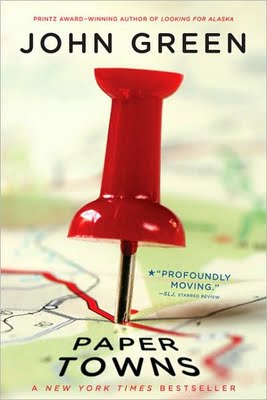
PAPER TOWNS: A REVIEW


A fascinating adventure of one seemingly-courageous-but-totally-freaked-out-geek in search of a beautiful, attractive, but totally freaked out teen rebel he’s absolutely in love with. A captivating, intricately planned road trip complete with a lot of weighty baggage and quirky, clever characters—this is what John Green’s Paper Towns is, his third young adult fiction novel after Looking for Alaska and An Abundance of Katherines.

Paper Towns follows the story of Quentin Jacobsen, also known as Q, and his quest to find his runaway ideal girl, Margo Roth Spiegelman, the archetypical attractive high school queen bee at Winter Park High School in Jefferson Park, Orlando, Florida. Margo, who’s had enough of the fake attitude of her friends and the controlling demeanor of her parents, decides to leave Orlando, aptly referred by her as a paper town.

“Here’s what’s not beautiful about it: from here, you can’t see the rust or the cracked paint or whatever, but you can tell what the place really is. You see how fake it all is. It’s not even hard enough to be made out of plastic. It’s a paper town.” – Margo (p. 80)

On the night before her departure, Margo takes Quentin in a joyride around Orlando, soliciting his help in exacting revenge against all the people who pretended to be her friend all that time. But more than a sinister payback scheme, the joyride proved to be the start of a long and arduous baptism of fire for Quentin, hatched by the courageous and scheming Margo.

When Margo disappears the following day, Quentin is baffled and goes on a fanatical search for her. Examining the different clues she left behind, Q tries to dig deeper into the Margo that he knew, but as he dug deeper, the more he realizes he doesn’t know Margo at all. That the real Margo is very far from the Margo he knew—smart, but reserved, damaged, and has a thing for escapism. He also learns more about himself than Margo as he progresses through the adventure: that he was capable of things he thought he can’t do before. This is where this charming young adult fiction turns into a heart-warming, thoughtful coming-of-age story.

Helped by clever and funny friends Ben, Radar, and Lacey, they analyze each clue for hints regarding Margo’s whereabouts. The whole process is excruciating, filled with a multitude of setbacks, misread clues, and out-of-nowhere disappointments. It was only when they go back to the very definition of “paper towns” that they realize what Margo was referring to and where she was—in the real paper town of Agloe, New York, a fictional town added to US maps to prevent copyright infringement. In the midst of this new found information, they hastily head out on a road trip across the East Coast to reach Margo before it was too late.

Paper Towns is the first John Green book that I’ve read. Before that, I became fascinated by John Green only through his YouTube vlog Crash Course: History. It was only when my blogger friend Clarisse E. mentioned The Fault in Our Stars that I realized that the John Green she was referring to was the same John Green I was watching and realized that he was an author too. Hence, I embarked on a journey to discover all things John Green.

John Green writes in an honest (sometimes too honest) and thoughtful voice through Quentin Jacobsen. You see an overanalyzing teen geek mushing over the sudden disappearance of his ultimate crush when Q talks. The right mix of sentimentality and comedy is what made the prose charming and attractive indeed. And while the book is dominated by geeky characters, Green did a good job of differentiating each one of them: the goofy and sometimes out-of-the-blue action star Ben Starling, and the ever-techie-help-a-friend-in-a-drop-of-a-hat Radar.

I read Paper Towns at a time when I was devastated by the sudden disappearance of someone I dearly loved, and somehow it helped me go through the process of moving on. How after two and a half years of being with her and thinking I knew her too well, I didn't know the real her after all. Or that I might have known the real her but time and distance had changed her too well that what I knew of her turned out to be false already. 

“When did we see each other face-to-face? Not until you saw into my cracks and I saw into yours. Before that, we were just looking at ideas of each other, like looking at your window shade but never seeing inside. But once the vessel cracks, the light can get in. The light can get out.” – Q, (p. 361)

In Quentin’s search, we are reminded of the challenges all of us go through in our own enigmatic road trips in life, and the bravery, cleverness, and audacity we have to muster in order to get to our destination and bask in the glory of having reached it. It also reminds us that ideals such as being there for our friends, getting to know ourselves and others better, and not giving up on people valuable to us, are still ideas worth their weight in gold.

In the end, Paper Towns is one book that I definitely loved reading and would like to recommend to teens and adults alike (but most importantly, to teens), whether geek or not. And when you finish reading, read it again. Every turn of the page is worth it.

Sunday, November 18, 2012

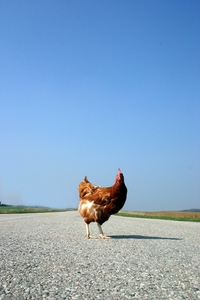
WHY DID THE CHICKEN CROSS THE ROAD?

Plato: For the greater good.

Karl Marx: It was a historical inevitability.

Machiavelli: So that its subjects will view it with admiration,
as a chicken which has the daring and courage to
boldly cross the road, but also with fear, for whom
among them has the strength to contend with such a
paragon of avian virtue? In such a manner is the
princely chicken's dominion maintained.

Hippocrates: Because of an excess of light pink gooey stuff in its
pancreas.

Jacques Derrida: Any number of contending discourses may be discovered
within the act of the chicken crossing the road, and
each interpretation is equally valid as the authorial
intent can never be discerned, because structuralism
is DEAD, DAMMIT, DEAD!

Thomas de Torquemada: Give me ten minutes with the chicken and I'll find out.

Timothy Leary: Because that's the only kind of trip the Establishment
would let it take.

Douglas Adams: Forty-two.

Nietzsche: Because if you gaze too long across the Road, the Road
gazes also across you.

Oliver North: National Security was at stake.

B.F. Skinner: Because the external influences which had pervaded its
sensorium from birth had caused it to develop in such a
fashion that it would tend to cross roads, even while
believing these actions to be of its own free will.

Carl Jung: The confluence of events in the cultural gestalt
necessitated that individual chickens cross roads at
this historical juncture, and therefore
synchronicitously brought such occurrences into being.

Jean-Paul Sartre: In order to act in good faith and be true to itself,
the chicken found it necessary to cross the road.

Ludwig Wittgenstein: The possibility of "crossing" was encoded into the
objects "chicken" and "road", and circumstances came
into being which caused the actualization of this
potential occurrence.

Albert Einstein: Whether the chicken crossed the road or the road crossed
the chicken depends upon your frame of reference.

Aristotle: To actualize its potential.

Buddha: If you ask this question, you deny your own chicken-
nature.

Howard Cosell: It may very well have been one of the most astonishing
events to grace the annals of history. An historic,
unprecedented avian biped with the temerity to attempt
such an herculean achievement formerly relegated to
homo sapien pedestrians is truly a remarkable occurence.

Salvador Dali: The Fish.

Darwin: It was the logical next step after coming down from
the trees.

Emily Dickinson: Because it could not stop for death.

Epicurus: For fun.

Ralph Waldo Emerson: It didn't cross the road; it transcended it.

Johann von Goethe: The eternal hen-principle made it do it.

Ernest Hemingway: To die. In the rain.

Werner Heisenberg: We are not sure which side of the road the chicken
was on, but it was moving very fast.

David Hume: Out of custom and habit.

Jack Nicholson: 'Cause it (censored) wanted to. That's the (censored)
reason.

Pyrrho the Skeptic: What road?

Ronald Reagan: I forget.

John Sununu: The Air Force was only too happy to provide the
transportation, so quite understandably the chicken
availed himself of the opportunity.

The Sphinx: You tell me.

Mr. T: If you saw me coming you'd cross the road too!

Henry David Thoreau: To live deliberately ... and suck all the marrow
out of life.

Mark Twain: The news of its crossing has been greatly exaggerated.

Molly Yard: It was a hen!

Zeno of Elea: To prove it could never reach the other side.

Chaucer: So priketh hem nature in hir corages.

Wordsworth: To wander lonely as a cloud.

The Godfather: I didn't want its mother to see it like that.

Keats: Philosophy will clip a chicken's wings.

Blake: To see heaven in a wild fowl.

Othello: Jealousy.

Dr Johnson: Sir, had you known the Chicken for as long as I have,
you would not so readily enquire, but feel rather the
Need to resist such a public Display of your own
lamentable and incorrigible Ignorance.

Mrs Thatcher: This chicken's not for turning.

Supreme Soviet: There has never been a chicken in this photograph.

Oscar Wilde: Why, indeed? One's social engagements whilst in
town ought never expose one to such barbarous
inconvenience - although, perhaps, if one must cross a
road, one may do far worse than to cross it as the
chicken in question.

Kafka: Hardly the most urgent enquiry to make of a low-grade
insurance clerk who woke up that morning as a hen.

Swift: It is, of course, inevitable that such a loathsome,
filth-ridden and degraded creature as Man should assume
to question the actions of one in all respects his
superior.

Macbeth: To have turned back were as tedious as to go o'er.

Whitehead: Clearly, having fallen victim to the fallacy of
misplaced concreteness.

Freud: An die andere Seite zu kommen. (Much laughter)

Hamlet: That is not the question.

Donne: It crosseth for thee.

Pope: It was mimicking my Lord Hervey.

Constable: To get a better view.

How about you, "Why did the chicken cross the road?"


Related Posts Plugin for WordPress, Blogger...