Showing posts with label Books. Show all posts

Sunday, May 25, 2014

BOOK REVIEW | The Fault in Our Stars

In sickness and in health: this is probably the motto of the relationship between Hazel Grace Lancaster and Augustus Waters, protagonists of what could be John Green's greatest work so far, "The Fault in Our Stars". The book has had a tremendous following worldwide that it now has a movie out this summer 2014.

TFIOS follows the lives of cancer patients Hazel Grace and Augustus who each have their own unique struggles with the disease. Hazel Grace had to live her whole teen life pulling an oxygen tank. Augustus had to live a life with a prosthetic leg. They are drawn together by their mutual disgust for the stereotypical treatment society has of cancer patients and their love for the author Peter van Houten, author of the fictional work, "An Imperial Affliction".

The couple prove that despite their depressing condition, they can live extraordinary lives and do what most people want at their age: make friends, travel, conquer fears, and fall in love. Hazel and Augustus goes to Amsterdam to visit Van Houten after the latter uses his wish from the Make-A-Wish foundation, in order to find out what happened to the characters whose lives Van Houten abruptly ended mid-sentence in his novel.

Instead of what they hoped for, they meet a grouchy, overbearing, alcoholic writer who cannot quite get a grip on his fame after writing a novel inspired by his daughter's death from cancer. They leave in disgust, unable to get the answers they were looking for. Before leaving Amsterdam, Augustus reveals to Hazel Grace that his cancer made a come back and has now spread throughout his body.

With this revelation, Hazel Grace's life turns into somewhat a real-life "An Imperial Affliction", as Augustus slowly turns to worse. Her affections for him faces the ultimate test: to love someone in the most miserable of conditions. Eventually, Augustus dies, much like the characters so untimely ended in Van Houten's novel. To Hazel Grace's surprise, the author shows up at Augustus' funeral and reveals to her the motivation behind the novel, but she is no longer interested in what he has to say.

A few days later, Hazel Grace finds out about several pages Augustus sent to Van Houten before he died. It is revealed that Augustus sent these so the author can write a fitting eulogy to Hazel. The novel ends with Augustus stating in his letter that "getting hurt in this world is inevitable, but we do get to choose who we allow to hurt us and that he is happy with his choice". He asks her if she is happy with his choice, and Hazel Grace aptly responds, "I do."

The greatness of this body of work by John Green lies in his ability to humanize the sick and to emphasize the potential and power of youth through his clever use and creative mix of comedy, tragedy, romance, and philosophy. We often view the physically disabled and the terminally ill with pity, as if they are beyond help. Green's strong and compelling characters break such stereotype along with the common misconception that teens aren't smart, critical, and make mature decisions.

Just like cooking rice, Green manages to bring our emotions and misconceptions to a boil leaving only a whiter, purer, softer, and tender understanding of the issues of sickness and adolescence: that we are not devoid of our humanity in the most dire of circumstances, that life is for us to have a noble death, that death is for the living, and that youth doesn't always mean immature.

"The Fault In Our Stars" film stars Shailene Woodley, Ansel Goort, and Willem Dafoe, and directed by Josh Boone using a screenplay by Scott Neustadter and Michael H. Weber, writers of "(500) Days of Summer". It opens in theaters in the Philippines, June 5.

Monday, September 16, 2013

Back to the Book Fair with The Social Scientist

The natural magnetism of printed books still captures the imagination of most Filipino bibliophiles. This is what the 34th Manila International Book Fair proved, which I’ve attended this Saturday at the SMX Convention Center in Pasay City.

The colors and the ambiance of the place do not immediately give away the drastic changes to this event. Since I first attended in 2009, the red and yellow tarpaulins marking the aisles, the smell of unsold stocks of books, the hard-to-maneuver alleys between exhibitors remain unchanged.

There are new folks here though, like the larger areas allotted for big name bookstores like National Bookstore, Fully Booked, and Goodwill. Big publishing houses are also kings this year, with Anvil, Rex, Diwa, Vibal, CentralBooks and Phoenix attracting clients to their Print-on-Demand, Publish-on-Demand, and e-book services. The increased number of foreign exhibitors gave the event a truly international vibe.

But there are old folks missing from this year’s fair too, like Scholastic Philippines (to my relief), who opted to exhibit only their Grolier encyclopedia division; also missing is an ex-girlfriend who introduced me to this fair five years ago, and a fellow blogger who I introduced to the fair last year. Going to the fair alone for the first time was truly surreal because I didn’t have anyone to discuss my book choices with or to chuckle with about interesting book finds.

I traversed every alley with one eye always looking at my shoulder for fear of who I might bump into. That was into the first twenty minutes inside the fair. Soon enough, I realized I won’t bump into any of my expectations with all the people moving their way like ants inside. Besides, if I did bump into them, why bother? I came for the book fair, not for the ex-girlfriend.

MR. ISAGANI CRUZ AND "HOW TO WRITE A BOOK"

The author together with Mr. Isagani Cruz and
friend Mr. Bob de Castro
By saying “I came for the book fair”, I wasn’t being exact. I actually came for the “How to Write a Book” seminar by Philippine Daily Inquirer columnist Isagani Cruz—an event which I waited too long to happen in a book fair like this. With me was my boss and fellow writer, Mr. Abraham de Castro, who happens to be the writing a book on Cory Aquino.

In a span of three hours, I found out that it wasn’t my consciousness of the critics, or the unavailability of time, or my novice book writing skills that’s preventing me from realizing my greatest dream—its myself. “To write, you have to write, whether its garbage or mediocre”, said Mr. Cruz. He added that “Writing begets writing, but it doesn’t start until you do something.”

In retrospect, I’ve written three unfinished novels since college, one of which was lost when I changed computers while the other two being works in progress. I also have an unfinished movie script with indie film director Eseng Cruz which we worked on this summer. I haven’t added new content to these works of art after the school year started because of work demands, laziness, or procrastination. I can’t seem to find the time or energy to continue writing them. But Mr. Cruz says, “What is the best time to write? Anytime, as long as it’s always the same time everyday.” He gave himself as an example, describing how he writes at 3 AM in the morning when there is less likelihood of disturbance and when his mind has fully rested and fresh with ideas.

Well, he must have been working in a really cozy room with a nice desk and comfy chair. Mine is a front row seat to a concrete wall thanks to the commercial building adjacent my window. However, when it comes to the best place to write, Mr. Cruz suggests, “Anywhere, as long it is always the same place.” He uses Filipino author Samantha Sotto as an example. She wrote her internationa best-selling novel “Before Ever After” in a Starbucks in front of the Ateneo de Manila University everyday while waiting to pick up her child who was studying in the aforementioned school. Of course, I won’t be chugging down on Starbucks coffee anytime soon considering my pay rate, but Sotto’s story gives my meager desk from SM Hypermarket a confidence boost. In fact, on Sunday, I gave it a good cleaning and decluttering. The rest of my room benefited from the process.

Mr. Cruz also made me realize that I was following the basic process of book writing all along—or a least most of it. In my two unfinished novels, I decided to do a deductive approach by 1) writing a synopsis of what the entire novel is all about before, 2) breaking down the synopsis into chapters and writing a synopsis for each, and finally, 3) writing the content for the chapters. I never got beyond chapters 3 and 7 for both novels respectively and so I never had the chance to take Mr. Cruz’s other steps which include:
  1. Idea – Brainstorming the main idea of the novel and its specific details
  2. Research – Conducting research about the fact to be contained in the novel
  3. First Draft – To be written without regard for chronological sequence of events, grammar, and facts and with different possible endings
  4. Fact Checking – To avoid any errors that might cause the author to lose face and credibility
  5. Second Draft – To be written this time with regard to chronological sequence, grammar, and facts
  6. Language Check – You don’t want to do a Venus Raj here that’s why
  7. Copy Editing – Writers don’t do this, according to Mr. Cruz. That’s why God created editors.
  8. Final Draft – To be saved as an e-file multiple times in different storage devices aside from printed in clean sheets of paper.
Mr. Cruz also advises not to rewrite your first draft and to save edits in a different filename each time so you can see how your novel evolved throughout its writing. He cites Ernest Hemingway as an example, who wrote 28 different endings for “A Farewell to Arms”. He emphasized the need for friends to look at your manuscript before publication, particular three kinds of friends: 1) The friend who reads and listens without commenting or judging, 2) The friend who reads, listens, and critiques, and 3) The copy-editor friend.

With the recent advent of Print-on-Demand and Publish-on-Demand services from various local publishing houses, its only a matter of time before I can finish my novel and have it printed. Most celebrated works these past few years like Ramon Bautista’s “Bakit Hindi Ka Crush ng Crush Mo” and CarlJoe Javier’s “And the Geeks Shall Inherit the Earth” were all independently published using such methods. In the case of Samantha Sotto, she had to sell her manuscript to literary agents first before it was picked up by Random House, which, for me, is a 50/50 gamble considering that your work may or may not be enticing and thus not reach the US market. It’s one gamble I am willing to bet on considering my connections and resources.

Writing begets writing. And so I’ll finish this article in the hopes of beginning where I left off in my novels and movie script. No matter how long Mr. Isagani Cruz and I got to know each other, it felt as if he’s been my mentor for a long time now. I would have wanted to say that he gave new inspiration to my writing but he did say that “There’s no such thing as writing because of inspiration”. Hence, I'd say has injected new energy into my writing with his insights. Because of him, who knows, (and this was suggested by Mr. Cruz himself) I might get this blog published in book form sometime soon.

Mr. Cruz, mag-dilang anghel ka sana! TSS

Thursday, March 21, 2013

THE SILVER LININGS PLAYBOOK: A BOOK REVIEW


SILVER LININGS AND ACCEPTANCE: these two are at the very core of Matthew Quick’s “The Silver Linings Playbook” which David O. Russel turned into a movie and landed Jennifer Lawrence her first Oscar award.

PLOT. The book tells the story of Pat Peoples, a 30-year old history teacher who suffers from bipolarism and traumatic brain injury and just got out of a mental hospital. He was incarcerated there for four year but in what Pat believes is just a few months after having a breakdown following his discovery of his wife, Nikki’s, infidelity.

Pat believes his life is a movie that will end with him reuniting with his ex-wife—what he calls his silver lining. So he embarks on a mission of self-improvement by working out, jogging, practicing being kind to people, and reading various American literature such as “The Catcher in the Rye”, “The Bell Jar”, and “Huckleberry Finn”.

In the midst of his self-improvement, he meets Tiffany Maxwell, a 35-year old widow who suffers from a similar mental disorder as Pat’s and is known in town for having had sex with different men after her husband Tommy died. At first, Pat ignores Tiffany until the latter offers to be his liaison in contact his ex-wife Nikki but only if he agrees to be her dance partner in a competition. He accepts the offer and begins a journey of getting to know Tiffany even better through dance and their companionship.

After Pat and Tiffany won in the dance competition, Tiffany begins being a liaison and Pat starts communicating with his ex-wife in a series of letters which revealed to Pat the shocking truth about his breakdown and her new marriage. Not dampened by the revelations, Pat decides to ask Nikki for one last meeting on Christmas Day, but instead, meets Tiffany, who reveals to him that she wrote the letters so Pat can finally accept the reality of his divorce and his new found life.

Pat get angry and runs away, only to be mugged and hospitably treated by Danny, his friend and former co-patient in the mental hospital. In the end, Pat decides to accept his fate after seeing Nikki living happily with her new family. He meets with Tiffany once more and both profess their love for each other while looking at clouds amidst a snowstorm.

HAPPY ENDINGS. We all dream of this in our fucked up lives. The ordinary reader might think Pat Peoples is unique because of his bipolarism and traumatic brain injury, but to me, we are all like him looking for that movie-like montage of our lives complete with background music. In fact, I believe so much that life is a movie that I even have a collection of movie themes which I play in my ear every time I'm on the go.

Just like Pat Peoples, we crumble in the realization that life isn’t the movie we hoped for—especially when circumstances turn sour and frustrating and pushes us to the edge. Some people even grow old thinking that life is just full of shit, without the silver linings Pat always anticipated. This should not harden our hearts and prevent it from beating a rush of optimism. Whether Pat People’s optimism is anchored on false hopes, in the end, such optimism helped him find the acceptance he wanted so much in his world: in the form of Tiffany Maxwell.

Tiffany did what no other woman could’ve done—to charge against social norms (that the woman should be chased and not the other way around) and to beat her own crazy self in order to reach out to Pat and eventually love him without reservation. As Pat said in the ending:
In my arms is a woman who has given me a Skywatcher's Cloud Chart, a woman who knows all my secrets, a woman who knows just how messed up my mind is, how many pills I'm on, and yet she allows me to hold her anyway.”
A LOVE WITHOUT RESERVATIONS. Isn’t that what we’ve always wanted? Someone to love us and we could love back despite our own imperfections? Someone who will always chase us even if we try to flee from the happiness life is offering us?

“The Silver Linings Playbook” teach us a valuable lesson in love, family, and relationships like no other book can and by putting us in the shoes of remarkably humane and genuine characters we can all find parallels in. Grab a copy of this book (or watch the film). There will be no regrets.

Friday, November 23, 2012

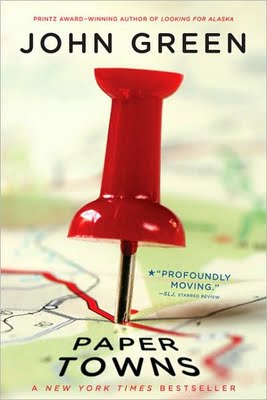
PAPER TOWNS: A REVIEW


A fascinating adventure of one seemingly-courageous-but-totally-freaked-out-geek in search of a beautiful, attractive, but totally freaked out teen rebel he’s absolutely in love with. A captivating, intricately planned road trip complete with a lot of weighty baggage and quirky, clever characters—this is what John Green’s Paper Towns is, his third young adult fiction novel after Looking for Alaska and An Abundance of Katherines.

Paper Towns follows the story of Quentin Jacobsen, also known as Q, and his quest to find his runaway ideal girl, Margo Roth Spiegelman, the archetypical attractive high school queen bee at Winter Park High School in Jefferson Park, Orlando, Florida. Margo, who’s had enough of the fake attitude of her friends and the controlling demeanor of her parents, decides to leave Orlando, aptly referred by her as a paper town.

“Here’s what’s not beautiful about it: from here, you can’t see the rust or the cracked paint or whatever, but you can tell what the place really is. You see how fake it all is. It’s not even hard enough to be made out of plastic. It’s a paper town.” – Margo (p. 80)

On the night before her departure, Margo takes Quentin in a joyride around Orlando, soliciting his help in exacting revenge against all the people who pretended to be her friend all that time. But more than a sinister payback scheme, the joyride proved to be the start of a long and arduous baptism of fire for Quentin, hatched by the courageous and scheming Margo.

When Margo disappears the following day, Quentin is baffled and goes on a fanatical search for her. Examining the different clues she left behind, Q tries to dig deeper into the Margo that he knew, but as he dug deeper, the more he realizes he doesn’t know Margo at all. That the real Margo is very far from the Margo he knew—smart, but reserved, damaged, and has a thing for escapism. He also learns more about himself than Margo as he progresses through the adventure: that he was capable of things he thought he can’t do before. This is where this charming young adult fiction turns into a heart-warming, thoughtful coming-of-age story.

Helped by clever and funny friends Ben, Radar, and Lacey, they analyze each clue for hints regarding Margo’s whereabouts. The whole process is excruciating, filled with a multitude of setbacks, misread clues, and out-of-nowhere disappointments. It was only when they go back to the very definition of “paper towns” that they realize what Margo was referring to and where she was—in the real paper town of Agloe, New York, a fictional town added to US maps to prevent copyright infringement. In the midst of this new found information, they hastily head out on a road trip across the East Coast to reach Margo before it was too late.

Paper Towns is the first John Green book that I’ve read. Before that, I became fascinated by John Green only through his YouTube vlog Crash Course: History. It was only when my blogger friend Clarisse E. mentioned The Fault in Our Stars that I realized that the John Green she was referring to was the same John Green I was watching and realized that he was an author too. Hence, I embarked on a journey to discover all things John Green.

John Green writes in an honest (sometimes too honest) and thoughtful voice through Quentin Jacobsen. You see an overanalyzing teen geek mushing over the sudden disappearance of his ultimate crush when Q talks. The right mix of sentimentality and comedy is what made the prose charming and attractive indeed. And while the book is dominated by geeky characters, Green did a good job of differentiating each one of them: the goofy and sometimes out-of-the-blue action star Ben Starling, and the ever-techie-help-a-friend-in-a-drop-of-a-hat Radar.

I read Paper Towns at a time when I was devastated by the sudden disappearance of someone I dearly loved, and somehow it helped me go through the process of moving on. How after two and a half years of being with her and thinking I knew her too well, I didn't know the real her after all. Or that I might have known the real her but time and distance had changed her too well that what I knew of her turned out to be false already. 

“When did we see each other face-to-face? Not until you saw into my cracks and I saw into yours. Before that, we were just looking at ideas of each other, like looking at your window shade but never seeing inside. But once the vessel cracks, the light can get in. The light can get out.” – Q, (p. 361)

In Quentin’s search, we are reminded of the challenges all of us go through in our own enigmatic road trips in life, and the bravery, cleverness, and audacity we have to muster in order to get to our destination and bask in the glory of having reached it. It also reminds us that ideals such as being there for our friends, getting to know ourselves and others better, and not giving up on people valuable to us, are still ideas worth their weight in gold.

In the end, Paper Towns is one book that I definitely loved reading and would like to recommend to teens and adults alike (but most importantly, to teens), whether geek or not. And when you finish reading, read it again. Every turn of the page is worth it.

Saturday, September 22, 2012

The Social Scientist @ The 33rd Manila International Book Fair


It was that time of the year once more when wages are set aside and daily allowances saved up for the much awaited event among Filipino bibliophiles: the Manila International Book Fair!

In its 33rd run, the longest running book fair in Asia aims to attract more Filipinos to the event and encourage the love of reading to everyone, but most especially to males (Hence, the all-male book ambassador line-up). But the MIBF need not to entice me with bibliophile geeks, gays, and nerds just to go and visit. Having attended my 1st MIBF in 2009, I’ve made it a point to religiously attend since then and now I’m in my fourth year. Each year, the book fair always had something special in store for enthusiasts like me which made us come back for more. But what makes this year’s MIBF special is that I got to spend it with a fellow bibliophile and writer, Clarrise, whose blog “Orchestroscopy” I’m a huge fan of.

Fans line up for Ramon Bautista's book signing. (Photo by Clarrise E.)
We went on a Saturday, on the 2nd to the last day of fair, which, when combined with a 3-day weekend sale, a CosPlay event, the collegiate basketball games, and a few rainshowers, made the SM Mall of Asia the smallest and most cramped mall in the world. Upon entering the Main Hall of the SMX Convention Center, the quintessential red and white arch of the country’s National Bookstore would greet visitors. Over to the right is book fair newbie, Fully Booked, the country’s fastest growing upscale bookstore. As my new buddy and I (it was the first time we met in person) strolled to the aisles and sections of the fair, we found more stalls selling religious books, big publishing companies (Rex, Diwa, Edcrish, Scholastic, and more), and companies selling educational tools and materials. I can’t help but have a sarcastic grin: this is just what we need every year in a book fair—big bookstores and publishers and tons of religious crap!

Gone are the rare stalls that offer one-of-a-kind books in prices that range from reasonable to dirt cheap. Back in 2009, I was able to buy a lot of stuff for a budget of Php 1000, including a Reader’s Digest atlas for my Geography students. Back then, Diwa Learning Systems still sold books and back issues of their classic Bato Balani and Damayan magazines. Now, their booth’s look and feel somehow gives you the feeling of being in a Consumer and Electronics Show rather than a book fair. And anywhere in the fair, you won’t find a unique and artsy bookmark which made my buddy a bit disappointed.

I don’t know if Pasay City has already banned plastics, but it doesn’t help the environment to know that the MIBF still uses plastics to package the merchandise they're selling. I hope this issue will be addressed in next year’s fair by encouraging readers to bring their own shopping bags.

The fair is not without its share of good traits as well. Amazingly, there are still a lot left for the kids as the major children’s book publishers are still around and going strong. Passing by Precious Hearts Publications, we saw the Tagalized version of contemporary bestselling novels such as Stephanie Meyer’s “Twilight”, and Suzanne Collin’s “The Hunger Games”. While it was only after the fair that I found out that these versions had a lot of language flaws, at least someone is setting a trend in the publishing industry by making foreign works more appealing to locals. However, let’s not bring up the issue of local works being translated and marketed to foreigners, as it is another issue that would take more than a blog post to tackle.  

UP and Ateneo de Manila Press have also offered a lot of great works from less-known but equally talented writers. For my MIBF haul, I was able to snag:

My MIBF haul from UP Press and Ayala Museum (Photo by the author)
“100” by UP Writer’s Club
A collection of bittersweet literary works by UP students

“And the Geek Shall Inherit the Earth” by Carljoe Javier
The first published work of a self-confessed geek and contains hilarious but amazingly realistic anecdotes of his daily experiences as a geek.

“The Filipino is Worth Blogging For” by Angela Stuart Santiago and Katrina Stuart-Santiago
An indie publication by a mother-daughter tandem and contains their positions and considerations of some of the country’s most crucial political and social issues to date.

“Pogi Points” by Stanley Chi
The not-so gentleman’s guide to looking good [for girls], as the sub-headline says.

While there were some disappointments on our part (my buddy didn’t get her bookmarks and wasn’t able to have her picture taken with Ramon Bautista), for me, this year’s book fair experience made quite a memorable impression me. It was the first time I’ve attended the book fair with a person who shares my passion for books and writing. All throughout our time together, we’ve exchanged ideas about our favorite authors and books, our writing styles and experiences, and got to learn more about each other on a personal level. What started as two mere online acquaintances turned out to be kindred spirits now embarking on a expedition to a great friendship!

“It was the most refreshing time I’ve had in months”, Clarrise said right after we parted and called it a night. I couldn't agree more. TSS

You can also read Clarrise's thoughts about the 33rd MIBF in her blog.

Related Posts Plugin for WordPress, Blogger...